As part of this initiative, we developed two proof-of-concept AI agents within the NT2 platform: the AI Writing Tutor and the Roleplay Agent, designed to support different proficiency levels while aligning with the official NT2 materials.
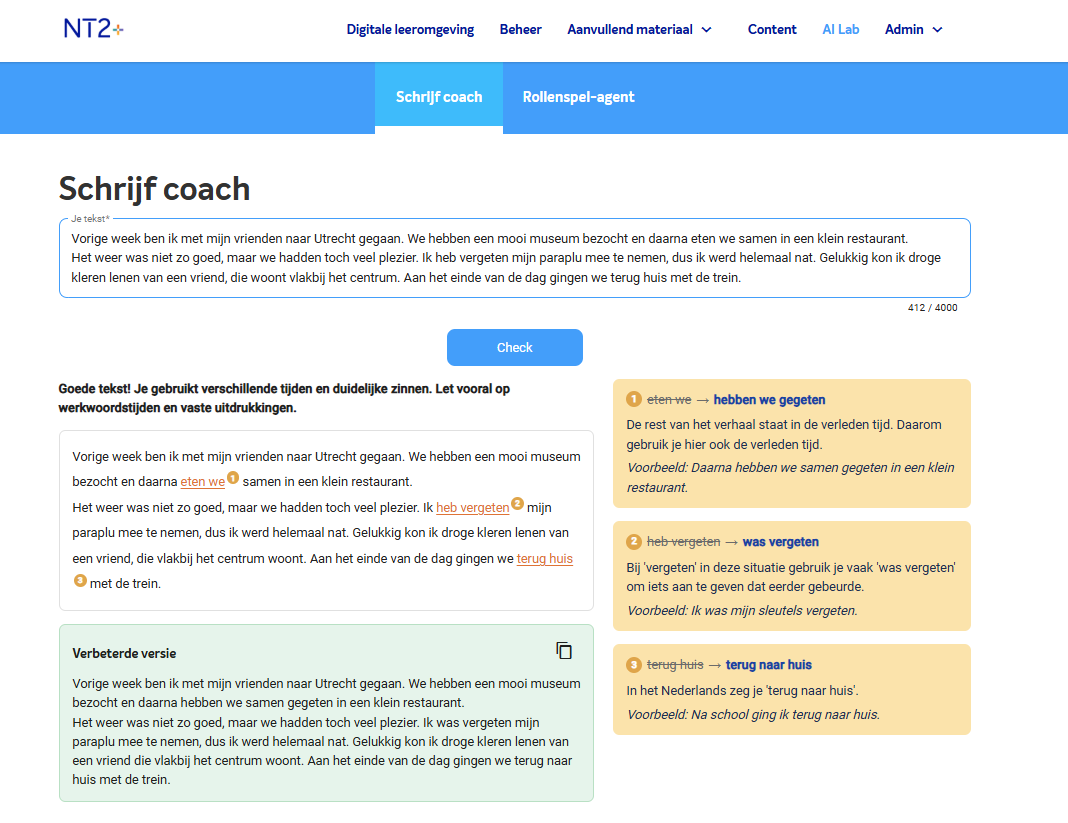
Writing Tutor
A personal writing space where learners upload their own texts and receive level‑appropriate corrections
Learners often know what they want to write but struggle to find the most natural or precise words in a new language. Their biggest challenge is uncertainty about proper phrasing, vocabulary use, and sentence structures that sound natural in the language. Because of this, many hesitate to write, worried about being judged for their errors, which can discourage them from practicing regularly and limit their opportunities for improvement. At the same time, students who do want to practice more often face another obstacle: teachers don’t always have enough time to give feedback on every writing assignment. To address both challenges and encourage students to step outside their comfort zone, we developed the Writing Tutor, which allows them to submit their own texts whenever they want, from essays and short stories to diary entries and written assignments, and receive immediate feedback in a safe environment, free from the fear of making mistakes or feeling embarrassed. The agent points out mistakes and offers clear explanations, correcting grammar, vocabulary, and spelling as well as suggesting alternative phrasing tailored to the student’s level of knowledge. Over time, learners gain a stronger grasp of Dutch grammar and sentence structure, enabling them to produce higher-quality written work.
Roleplay Agent
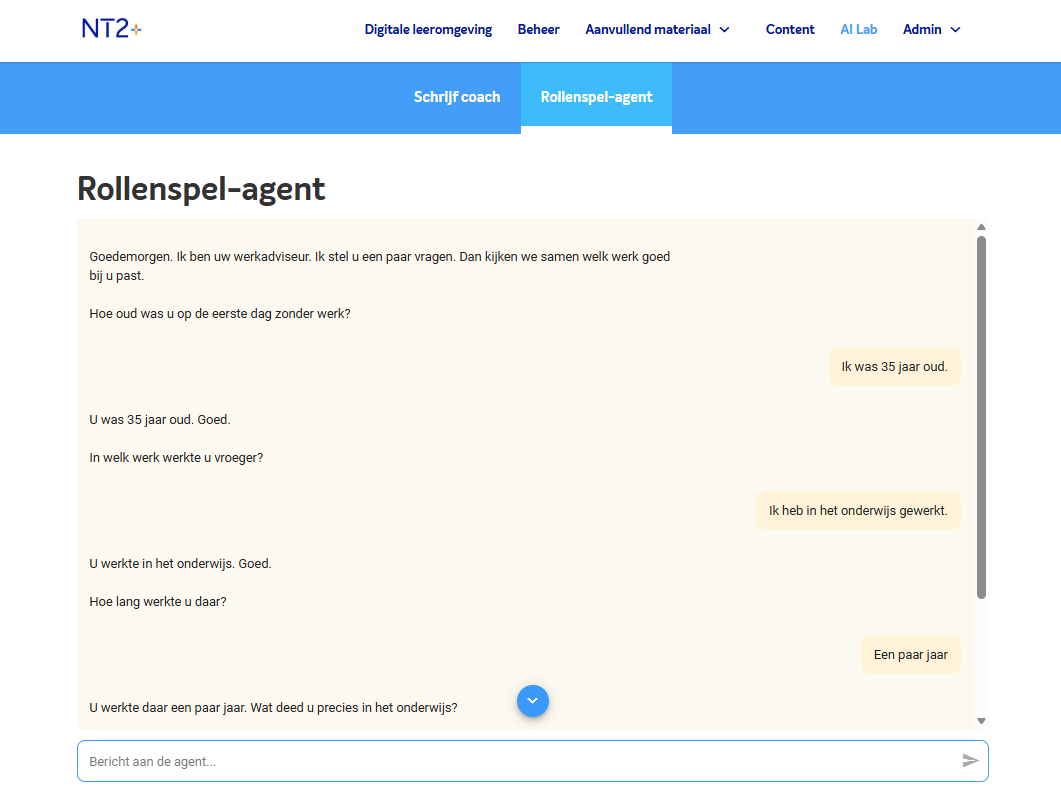
A conversational AI that simulates real‑life situations, which learners are likely to encounter while living in the Netherlands.
The Roleplay Agent was made to prepare students for real-life interactions while living in the Netherlands, allowing them to practice the use of the vocabulary and grammar that they learn in class. The agent works in the form of a chat in which the learner can select a role depending on who they wish to interact with, i.e. baker, cashier, bus driver, UWV consultant, etc. In contrast to the Writing Tutor, the Roleplay Agent is designed not to interrupt conversations with corrections, but to create a space where students can experiment with Dutch, build fluency, and communicate without hesitation. As a result, learners feel more comfortable engaging in everyday conversations, increasing their active use of Dutch and confidence in communicating both inside and outside the classroom.
How does it work?
The complexity of both the conversations and available roles adapts to the learner’s language level, gradually increasing as their skills develop. Currently, the implemented role is designed for A1–A2 learners, with the AI taking on the role of a UWV consultant to simulate a realistic and relevant scenario for newcomers in the Netherlands. Both agents are grounded in the grammar and vocabulary covered in official NT2 learning materials, with carefully designed guardrails ensuring that interactions remain relevant, safe, and aligned with sound pedagogical principles.
How were the agents built?
Both agents were developed in Microsoft Foundry, Microsoft's managed platform for building and running AI agents. Working inside the Foundry portal gave us a controlled environment to experiment before committing to a design. We could try out different models from the Foundry model catalogue, adjust generation parameters such as temperature and response length, and carefully refine each agent's system prompt, the underlying instructions that shape its tone, behaviour, and pedagogical boundaries. Because the Writing Tutor and the Roleplay Agent serve very different purposes, this flexibility was essential: one needed to correct precisely and explain clearly, while the other needed to stay in character and resist the urge to interrupt with corrections.
Throughout this stage we tested each configuration directly in the agents playground, comparing how different combinations of model, parameters, and instructions performed against realistic NT2 learning scenarios. This allowed us to iterate quickly and evaluate the quality of the feedback and conversations until the behaviour aligned with the curriculum and with sound teaching principles.
Once we were satisfied with the results, we published the agents through the Foundry API, exposing each one through its project endpoint using Foundry's Responses API. This gave the NT2 application a stable and secure way to call the agents programmatically, so the Writing Tutor and the Roleplay Agent could be integrated seamlessly into the learning platform that students and teachers already use, without any of the underlying model configuration needing to live in the application itself.
Value for teachers
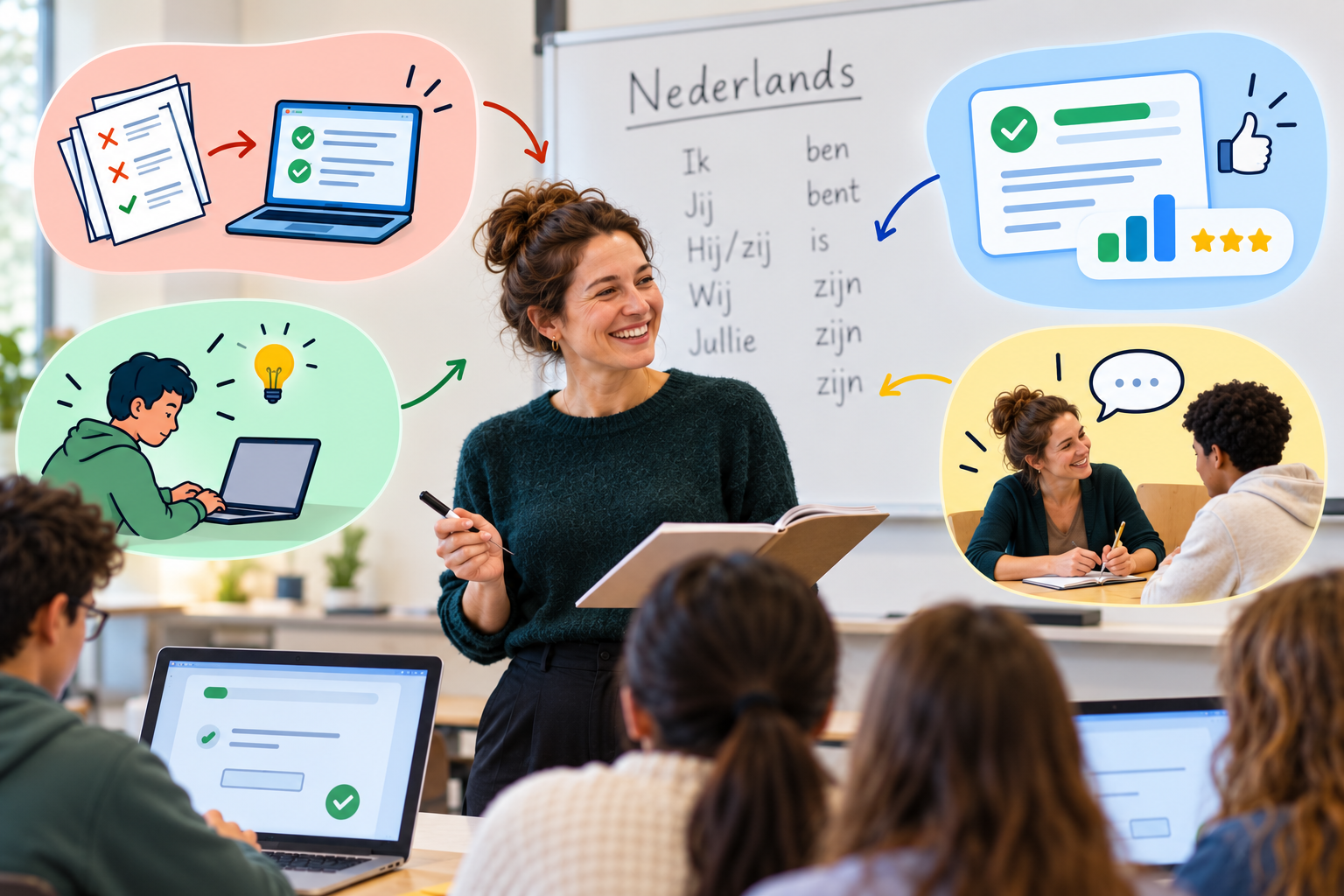
The AI agents act as supportive extensions of the classroom, helping by:
- reducing repetitive correction work
- offering consistent, level‑appropriate feedback
- giving students more opportunities to practice independently
- freeing up teacher time for deeper explanation and personal guidance
Because the agents are aligned with the official NT2 materials, teachers can trust that the feedback and conversations reinforce what is already being taught. The agents build only on what students have already learned, so they never introduce new or conflicting grammar rules or vocabulary that hasn’t been covered yet.
Value for learners
- level‑aware feedback that grows with the student
- more practice opportunities without additional pressure
- realistic language use tied to daily life in the Netherlands
- better balance between independent learning and teacher support
- increased confidence in writing and speaking Dutch

Conclusion
By combining curriculum-aligned content with adaptive AI, the NT2 project demonstrates how technology can make language learning more supportive, engaging, and human-centered. By providing learners with personalized guidance, opportunities for meaningful practice, and a safe environment to experiment with the Dutch language, AI agents can complement traditional education and help bridge the gap between classroom learning and real-world communication. This approach empowers students to learn at their own pace while receiving the support they need to build stronger language skills and greater confidence in their everyday use of Dutch.